
Those of us engaged 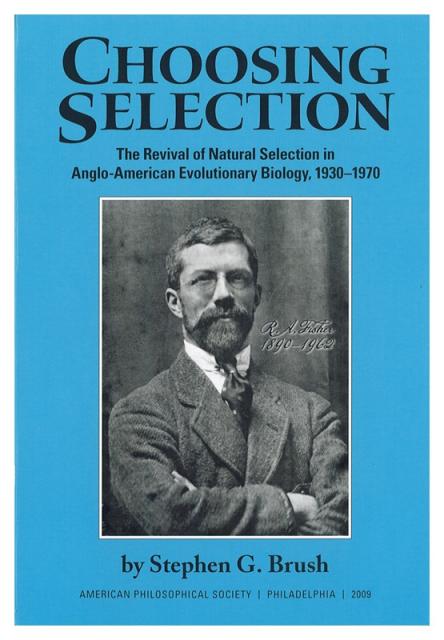 in defending
the teaching of evolution in public
schools are aware of the need
to understand evolution properly.
For example, we emphasize that
selection and evolution are not the
same thing, pointing out that there
are a number of evolutionary
processes, for example, selection,
drift, mutation, and migration. And
we point out that debate among
biologists over the relative importance
of different evolutionary
processes is often deliberately misrepresented
by creationists.
However, it is also important to
understand the history of the
debate over evolutionary processes,
that is, how it is that we came to
hold the views concerning the relative
importance of selection that
we hold today. Stephen G Brush,
perhaps most well known as a
physicist and a historian of
physics, seeks to help us understand
that debate as it occurred in
the mid-20th century. In that, he is
mostly, if not entirely, successful.
in defending
the teaching of evolution in public
schools are aware of the need
to understand evolution properly.
For example, we emphasize that
selection and evolution are not the
same thing, pointing out that there
are a number of evolutionary
processes, for example, selection,
drift, mutation, and migration. And
we point out that debate among
biologists over the relative importance
of different evolutionary
processes is often deliberately misrepresented
by creationists.
However, it is also important to
understand the history of the
debate over evolutionary processes,
that is, how it is that we came to
hold the views concerning the relative
importance of selection that
we hold today. Stephen G Brush,
perhaps most well known as a
physicist and a historian of
physics, seeks to help us understand
that debate as it occurred in
the mid-20th century. In that, he is
mostly, if not entirely, successful.
Brush’s thesis is that the “Natural Selection Hypothesis” (NSH) came to be accepted by a “bare majority” of evolutionary biologists in the 1950s and 1960s. The NSH is “the hypothesis that natural selection, with an ample supply of variation in heritable characters, is not only the major process involved in evolution (with the help of geographical isolation or polyploidy in some cases), but also that Lamarckian effects, random genetic drift, and macromutations have essentially no evolutionary significance” (p 2; emphasis in original). The thesis is, on the whole, reasonably uncontroversial, but the devil is in the details. Brush focuses almost exclusively on what he calls the “competition” between natural selection and random genetic drift (roughly, the question of whether changes in populations over time are due to differences in fitness or due to chance); there is little discussion of other evolutionary processes or other processes involved in evolution, such as development. Furthermore, many biologists in fact disagreed, and the “majority” position did not remain the majority position past 1970. Finally, and very unfortunately in my view, Brush has left out a detailed discussion of Sewall Wright’s shifting balance theory and Motoo Kimura’s neutral theory of molecular evolution, both of which were influential views developed during the period Brush is covering and both of which posited a substantial role for drift and selection (defying the “either selection or drift, but not both” way of thinking that sometimes characterized this period).
The thing to understand is that the truth of the reception of the NSH is complicated; people’s views changed over time and could not necessarily be neatly categorized as “accepting” or “rejecting” the NSH. The truth is also difficult to uncover, because like any family dispute where there is widespread general agreement, but disagreement over details (in this case, the particular ways in which evolution is proceeding), arguments can get heated, and it is difficult to find neutral parties whose accounts we can trust.
Brush categorizes his book as a “reception” study, stating that while we have studied the reception of Darwin’s views immediately after 1859 and the early 20th century, we have not studied the reception of what Brush calls “the modern version of Darwin’s theory” in the mid-20th century. The book offers a synthesis of the Modern Synthesis literature, together with a detailed examination of its citation patterns, which (to my knowledge) has not been done previously. Of particular interest to readers of RNCSE will be the discussion of the different types of evidence for selection that influenced mid–20th-century evolutionary biologists. Many of these remain classics in the field.
Brush’s concern is with the empirical reasons why the NSH had the reception it did. He particularly emphasizes the confirmation of “novel” predictions (prediction of facts that were not known at the time that the prediction was made). If the theory of natural selection were to make such predictions, it could either be corroborated or be falsified; in other words, it would be falsifiable. This raises another pair of issues: whether falsifiability is a criterion that demarcates science from pseudoscience and whether the theory of natural selection is indeed falsifiable. Brush suggess that falsifiability is important but should not be considered the sole criterion and argues that the biologists of this period themselves did not seem concerned with confirmation of novel predictions, though many were in fact confirmed. I think readers will enjoy the examples here, especially the brief history of the use and misuse of the falsifiability criterion in creationist attacks on evolution.
I highly recommend Choosing Selection for anyone interested in evolution. Scholars familiar with this period will come away having learned some things they didn’t know and will appreciate Brush’s provocative position on a provocative subject; those new to this area will be introduced to the main players and will receive a wealth of pointers to both primary biological literature and secondary historical and philosophical literature.