
When the 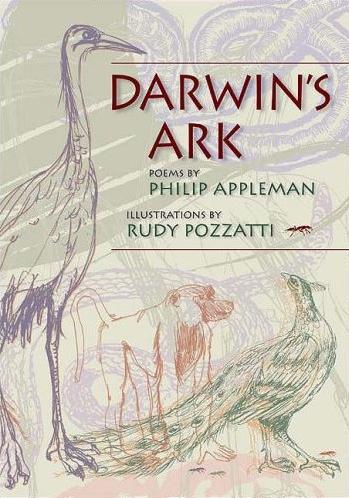 National Center for
Science Education asked me to
review Darwin’s Ark, I demurred,
saying I was not a scientist and
while a sometimes poet, certainly
not Philip Appleman’s peer. As for
drawings, I only know what I like.
The NCSE replied I was exactly
what they wanted. Feeling somewhat
ridiculous, I agreed. But as
Appleman points out so aptly in
his poems, Homo sapiens many
times is ridiculous. Appleman is
the Distinguished Professor of
English Emeritus at Indiana
University and author of eight volumes
of poetry, three novels, and
six non–fiction books including the
Norton Critical Edition of Darwin.
Rudy Pozzatti is Distinguished
Professor of Fine Arts Emeritus at
Indiana University, whose art
resides in museums and public and
private collections worldwide.
National Center for
Science Education asked me to
review Darwin’s Ark, I demurred,
saying I was not a scientist and
while a sometimes poet, certainly
not Philip Appleman’s peer. As for
drawings, I only know what I like.
The NCSE replied I was exactly
what they wanted. Feeling somewhat
ridiculous, I agreed. But as
Appleman points out so aptly in
his poems, Homo sapiens many
times is ridiculous. Appleman is
the Distinguished Professor of
English Emeritus at Indiana
University and author of eight volumes
of poetry, three novels, and
six non–fiction books including the
Norton Critical Edition of Darwin.
Rudy Pozzatti is Distinguished
Professor of Fine Arts Emeritus at
Indiana University, whose art
resides in museums and public and
private collections worldwide.
I first became aware of Philip Appleman’s ability to take seldomaddressed subjects, put them into poetic form, and subject them to public scrutiny in 1984 when his poem “The Skeletons of Dreams” hit me with the power of a hydrogen bomb. I sang its praises in freethought newsletters and read it to graduate students attending a talk at Guangxi Province Teachers’ University in Guilin, China. I was awestruck the many times I have read the poem since.
The poem first appeared in The New York Times and was subsequently included in his 1984 collection of poems entitled Darwin’s Ark. But “Skeletons” is only one star in a glittering galaxy of poems and illustrations (and excerpts from writings by Darwin and others) that add to this volume. Appleman illuminates his theme with empathy, understanding, wit, and humor that is often subtle or satirical. Pozzati’s illustrations, while often whimsical, are also realistic and memorable.
The words and drawings in Darwin’s Ark brilliantly exhibit Darwin’s theory of evolution, starting with “Skeletons of Dreams”. In it Appleman includes these cautionary words,
Back home in his English garden
Darwin paused in his pacing,
writing it down in italics
in the book at the back of his mind:When a species has vanished
from the face of the earth,
the same form never reappears ...
The poem goes on to point out humanity’s acquisition of an opposable thumb and an expanded cerebral cortex, and the millennia linking us to our ancestral past, while pointing out that our species is still as mortal as mammoths.
All of the poems delineate, describe, or elaborate on Darwin’s theory. The connections between us and them, humanity and the “lesser” animals, slide effortlessly into place, and the very earth we stand on oozes into our consciousness as we read these poems. Appleman blends the past with the present in an elegant fashion.
A sensitive, analytical writer, Appleman takes us into the scenes he paints with his words. We are the lions in the veldt. We feel the sense of urgency in the hunt, whether it is in grasslands in Africa or pews in churches, preachers “baying at sin.” He uses metaphor in amusing ways as well, and we read about the evolution of automobiles, the passing of Cords and Duesenbergs, and “animals tame and animals feral.” Rhymed or unrhymed, all the poems sing with the rhythm and the judicious choice of words.
The book is separated into four sections, Giants in the Earth, The Rust of Civilizations, Animals Tame and Animals Feral, and In the Caves of Childhood. The poems in each section tie the present to all that went before and at times point to the future. In an additional breakdown of the section highlighting animals, we find Phobias (fears) and Euphorias (joys), and these playful seeming titles end up, by the end of the poems, giving us very big challenges, making us look at ourselves and what we have wrought.
Open the book anywhere and you are apt to find an image that expands in your mind, becomes more because of the verbs used — “the concrete is veined with tar bubbling in the sun” or “the land is failing the horizons.” Again a wellchosen adjective lifts a narrative above the obvious such as “to pray above our crippled brother seven raptured hours.”
Darwin’s observations and conclusions have been encapsulated and given back to us in poetic form expanding on the various concepts Darwin noted. We encounter the “survival of the fittest.” We know what it means in a visceral, on–the–scene way in the cold regions of Tierra del Fuego during the “spirit” years. We know what it is to be hungry, when food exists only in another like ourselves. We know what it is to be the hunted, to be the prey. Likewise Appleman makes clear that Noah’s Ark was “not floating on fact but was floating on faith”. Darwin’s Ark floats on word images and the underlying science as well as the social behavior that speaks and lives for all times.
The poem “Reading Our Times” contains the following end lines:
we push though the bars
to Wall Street, promised land,
land of silk and honey,
bearing our Times
into the screaming of monkeys,
into the streaming baobab,
ivory, apes, and peacocks,
hacking at dripping lianas
with our machetes, tracking the gamy spoor
of Honor.
The prescient lines could have been written today.