
As a theologian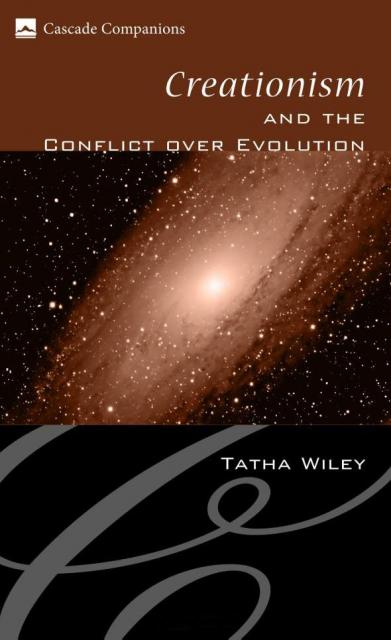 at the University of
St Thomas (St Paul, Minnesota),
Tatha Wiley engages Darwinian
thought in order to gain insight
into the doctrines of Christianity.
She emphasizes that the theological
concept of creation contrasts
with the anti–evolutionists’ political
definition of “intelligent
design” (ID) creationism — a neo–Paleyan
construct based in the
teleological argument for God. She
agrees that supernatural agency
must be “bracketed” when doing
science. Unless one misreads
Genesis as offering an alternative
scientific explanation, there is no
conflict between Christianity and
Darwinian science.
at the University of
St Thomas (St Paul, Minnesota),
Tatha Wiley engages Darwinian
thought in order to gain insight
into the doctrines of Christianity.
She emphasizes that the theological
concept of creation contrasts
with the anti–evolutionists’ political
definition of “intelligent
design” (ID) creationism — a neo–Paleyan
construct based in the
teleological argument for God. She
agrees that supernatural agency
must be “bracketed” when doing
science. Unless one misreads
Genesis as offering an alternative
scientific explanation, there is no
conflict between Christianity and
Darwinian science.
Fundamentalists see the Genesis stories as history and science. Wiley explains why the antimodern and anti–intellectual fundamentalist movement in the US, with its idea of a “plain sense” reading of Scripture, is just flat wrong. Ever since the inception of The Fundamentals in 1909, fundamentalists have ignored a more informed biblical scholarship. Reading the creation stories as symbolic narratives, instead of history, transforms Adam and Eve into a metaphor for human experience; it is a non sequitur to claim that doing so makes Christ a metaphor as well. What impels this non sequitur is what Wiley calls the “fundamentalist anxiety.” Understanding this anxiety, Wiley suggests, should help us gently communicate the science of evolution to fundamentalist students.
The theological concept of creation and evolution address two different realities on both ontological and epistemological levels. They are complementary answers to different questions: whys versus hows. Wiley makes clear that theology, done properly, addresses metaphysical questions of human existence. Questions of an ultimate source of the universe (God) belong to metaphysics and outside the bounds of science. Taking what was meant to be a hymn of praise to encourage exiles to remain loyal to Yahweh (Genesis 1–3) and turning it into a science and history lesson is an incompetent exposition of scripture. Science, by its very nature, must limit itself to physical questions. Just as we wish to keep ID out of our classrooms, we must also keep out metaphysical claims that science proves a dysteleological or atheistic cosmos.
Wiley highlights the flaws of the teleological argument, which claims the order of the cosmos indicates a designer. Rather than ignore the dysfunctions and cruelties in nature, which Paley’s natural theology failed to explain, Darwin solved the conundrum by proposing that whatever allows the better proliferation by an individual in a given environment is what truly counts, not how perfectly that individual serves a purpose in nature. More importantly, natural selection is an empirically based explanation amenable to testing and verification.
Wiley also explains how Roman Catholics have used evolution to inform theology. Both advances in evolutionary science and the work of biblical scholars continued to question the historicity of Adam and Eve and thus the doctrine of original sin. Developed primarily by St Augustine and given dogmatic status by the Council of Trent in 1563, the doctrine reflected a medieval worldview. The Church began considering evolution and modern critical methods of biblical scholarship seriously in 1943. By 1950, Pope Pius XII cautiously accepted evolution but could see no apparent way to reconcile it with the doctrine of original sin.
By 1996, Pope John Paul II recognized evolution as “more than a hypothesis”, noting that even if the body is brought into being by evolutionary processes, the soul is immediately created by God. By shifting to a mystical “ensoulment” of an “Adam” (humankind), he moved the discussion to one of metaphysics outside the purview of science. In 2004, a Vatican statement accepted evolutionary theory as compatible with divine purpose warning only that science should never engage in metaphysical claims that the cosmos has no purpose, humans have no ordained role to play, or God has no function in an evolving universe.
Fundamentalists never signed on. Some of them became a political movement focusing, via the Discovery Institute, on “irreducible complexity”, requiring an “intelligent designer”. Their “God–of–the–gaps” arguments make God dispensable when intelligible natural explanations eliminate the gaps in current knowledge. Consequently, ID does no favors for theology. Good theology prefers God to remain mysterious and ineffable rather than continuously shrinking as gaps are filled.
The insistence that science restrict itself to the study of natural causes is not a rejection of God’s existence. It is a methodological approach to limit science to what is testable. The ID camp fails to understand that science is limited to discovering secondary causes of contingent events (such as laws of nature). Science must bracket a primary cause of those laws. Seeing God as the ultimate source of secondary causes allows theologians to understand him or her as the prime mover, the ground of being itself ... conceptions that belong to metaphysics. ID casts God as a tinkerer who could not get it right the first time — poor science but even worse theology.
The final chapter focuses on the crux of the conflict: without a historical Adam and Eve in Eden, is Christ’s atonement moot? I have to wonder why Wiley was not more forthright in answering with a resounding “no” since her previous publications do this quite well. If I can fault this work at all, it would be here. After all, the resolution of anti–evolution as pointed out by Wiley, echoing Eugenie C Scott’s position, is to educate both scientists and theologians: to allow both to become better informed about biblical scholarship and what scriptures are actually teaching regarding the doctrine of creation. Personal interpretation of Scripture without solid theological insight — so–called plain “sense” readings — must be rejected ... as the Ethiopian admitted when Philip asked him:
Do you know what you are reading?
How can I, unless someone explains it to me? (Acts 8:30–31).