
Last year’s twin anniversaries of Charles Darwin’s birth in 1809 and the publication of his On the Origin of Species in 1859 prompted a string of books on the life of the English naturalist who was so concerned about his evolutionary findings that he delayed their publication for twenty years. Yet there was a woman, also raised religious, who helped blaze the trail for Darwin — an often forgotten and dismissed fossil hunter who was just as surely tortured by her own bizarre discoveries, but who ultimately came to accept the evolution of life.
Born in 1799, 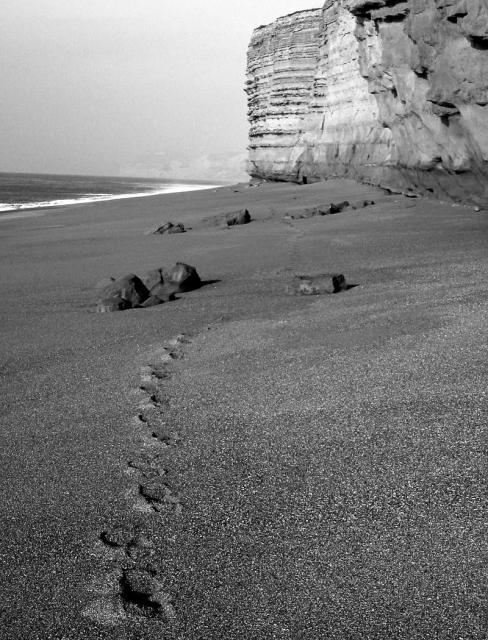 The coast of Lyme Regis, where Mary Anning searched for fossils. Photo by Mary Emling.Mary Anning —
the dirt-poor woman said to have
inspired the tongue-twister “She
sells seashells by the seashore” —
would spend her entire life uncovering
and piecing together the fossils
of one never-before-seen monster
after another: organisms that
had been hidden away for nearly
200 million years in the cliffs up
and down England’s southern
coastline. In short, she provided raw
material to the scientists — all male
— that would be instrumental in
forming their evolutionary theories.
Stephen Jay Gould later remarked
that Anning is “probably the most
important unsung (or inadequately
sung) collecting force in the history
of paleontology” (quoted in Jo
Draper’s Mary Anning's Town:
Lyme Regis (Dorchester [UK]:
Dorset County Council, 2004). Yet
Anning’s place in history happened
quite by accident.
The coast of Lyme Regis, where Mary Anning searched for fossils. Photo by Mary Emling.Mary Anning —
the dirt-poor woman said to have
inspired the tongue-twister “She
sells seashells by the seashore” —
would spend her entire life uncovering
and piecing together the fossils
of one never-before-seen monster
after another: organisms that
had been hidden away for nearly
200 million years in the cliffs up
and down England’s southern
coastline. In short, she provided raw
material to the scientists — all male
— that would be instrumental in
forming their evolutionary theories.
Stephen Jay Gould later remarked
that Anning is “probably the most
important unsung (or inadequately
sung) collecting force in the history
of paleontology” (quoted in Jo
Draper’s Mary Anning's Town:
Lyme Regis (Dorchester [UK]:
Dorset County Council, 2004). Yet
Anning’s place in history happened
quite by accident.
By birth, Anning never should have become an influential fossil hunter and geologist. She was marginalized not only by her family’s poverty but also by her sex, her regional dialect, and her nearly complete lack of schooling. But she enjoyed one natural advantage: the very good fortune of having been born in exactly the right place at the right time, alongside some of the most geologically unstable coastline in the world; it was — and still is — a place permeated with fossils.
After her father died in 1810, young Mary’s family was in dire financial straits. In order to put food on her table, she was forced to run the shore’s gauntlet of high tides and landslides to hunt for curiosities that she could sell to seafaring tourists. If she hadn’t, her family very well could have starved.
Her first discovery, made in 1811 when she was only 12 years old, was of the fossil of an ichthyosaur, a marine reptile about four feet in length with flippers like a dolphin and a chest like a lizard. At first people thought it must be a crocodile. In time, though, the specimen attracted massive crowds to museums in London, where many soon realized the skeleton was of a creature never before seen.
Indeed, a wide range of lifeforms had been safely deposited in ancient sea beds up and down the coast near Lyme Regis, Anning’s hometown, rendering the region’s stratigraphy uniquely able to store (and later reveal) evidence of 200 million years of evolution. Scientists eventually discovered that the cliffs east and west of Lyme Regis portrayed an almost continuous sequence of rock formations spanning the entire Mesozoic Era, perhaps better than any other locale on the planet. Until the early 1800s, though, the area’s residents had no knowledge of this rich resource.
The strange fossils found along England’s southern shoreline had baffled the locals for as long as anyone could remember. They came in all forms and sizes — including what later were determined to be bivalves, ammonites, belemnites, and brachiopods — and sometimes even the fragments of giant critters never heard of before. Some people thought the fossils were so lovely and delicate that they surely must be God’s decorations, allowed to bubble up from the inside of the earth, a bit like flowers were allowed to ornament the outside. Others thought they must be the remains of the victims of the global flood recorded in Genesis.
Like most everyone in England at the time, Anning and her neighbors had absolute faith in the fact that species never evolved or became extinct. Everything that existed had always existed. Yet the fossils that Anning uncovered as a young woman — including many of the world’s first ichthyosaurs, plesiosaurs, and pterodactyls — had never been seen by anyone, anywhere before.
Indeed her discovery of a nearly intact long-necked plesiosaur (Plesiosaurus dolichodeirus) in 1823 was so incredible that even the celebrated French anatomist Georges Cuvier did not believe it could be valid. It was only after British geologist William Conybeare defended Anning’s find — and verified that the neck did indeed boast at least 35 vertebrae — did Cuvier admit he was wrong. Eventually he pronounced Anning’s fossil a major discovery.
As Anning aged, and began working alongside Britain’s clique of male geologists — most of them Anglican clergymen — there were countless attempts to use biblical stories to explain the new knowledge about the natural world that resulted from her fossil discoveries. For example, Anning’s friend and associate William Buckland — the well-known English geologist and first professor of geology at Oxford — believed that the fossils found at high altitudes proved that a great flood had once covered the planet, just like the Flood described in the Bible.
Anning worked alongside Buckland for years, not only combing the beach looking for fossils, but also in the study of fossilized feces known as coprology. Anning had found many stones about four inches long inside the skeletons of ichthyosaurs, leading her to believe they might be fossilized clumps of undigested food. Soon they both concluded the stones were feces, which helped them figure out what the creatures had eaten.
In her later years, she also assisted the Swiss naturalist Louis Agassiz during his visits to Lyme Regis. Agassiz was best known as the first person to propose the scientific concept of an Ice Age in 1837. For years he strongly advocated the prime role of glaciers in bringing about physical changes in earth’s crust that had formerly been attributed to the biblical Flood. Agassiz had worked closely alongside Cuvier, who believed that the earth was immensely old and also that periodic catastrophes had wiped out a number of species. At the same time, a rival French intellectual, Jean-Baptiste Lamarck, proposed transmutation, arguing that organisms could transform in such a way that higher forms could emerge from lower ones.
Anning’s views on the flood and the disparate theories of the male scientists of her era are not known. But in 1833, she was visited by a tourist, the Reverend Henry Rawlins, and his six–year-old son, Frank. Rawlins believed that God created the world within a week, but Anning described to young Frank how the fossils purchased by his father had been found by her at all different levels in the cliffs, explaining that this meant the creatures possibly had been created and had lived at different times. According to Frank’s journals, his father refused to discuss the issue after they left Anning’s home.
One can only imagine how frightening it must have been for Anning to find the fragments of these exotic creatures — with their bat-like wings, snake-like necks, and big, bulging eye sockets — and wonder if perhaps the live versions were not about to fly out of the sky or come up out of the sea to terrorize her. The puzzle of Anning’s specimens weighed on the public’s mind as well. Many religious leaders were convinced that her ichthyosaur and other fossil finds were soiling the sacred teachings of the Bible. “Was ever the word of God laid so deplorably prostrate at the feet of an infant and precocious science!” exclaimed an exasperated evangelical Anglican pastor named George Bugg, author of Scriptural Geology, written in 1826.
But according to most accounts from her friends, Anning continued to be a deeply meditative woman who often could be found praying or reading the Bible and who almost never missed a Sunday service. Anning’s close friend, Anna Maria Pinney, wrote of how the two often talked of the idea of creation and other spiritual topics. “To think that life shall never have an end quite fills the mind, but to think of God without a beginning is more than a created being can comprehend,” Pinney wrote.
Anning tried to reconcile what she was unearthing with her belief in God’s omnipotence, a belief she apparently held until her death from breast cancer at the age of 47. Some of her letters to friends suggest that she grew to accept that there had been a progression of living things. A few years before she died, she remarked that — from what she had seen of the fossil world — there is a “connection of analogy between the Creatures of the former and present World.” From most accounts, it seems she continued to believe in God throughout her life, but that she also came to accept that evolution was part of God’s plan. Toward the end of her life, she copied into her journals many poems and passages laced with religious overtones.
At the Natural History Museum in London, as well as a small museum in Lyme Regis, Anning is recognized as having laid the groundwork for the theory of evolution, not to mention nearly two centuries of discoveries in the stillevolving worlds of paleontology and geology. Today thousands of people continue to go hunting for fossils along England’s so-called Jurassic coast — a 95-mile stretch of shoreline declared a Unesco World Heritage Site in 2001. And, to this day, real and startling discoveries are still being made, such as the skeleton of a 195-million–year-old Scelidosaurus, the earliest of the armored dinosaurs, in Anning’s hometown of Lyme Regis a few years ago.
With over 700 species of dinosaurs already identified and named, reminders of the prehistoric past just keep on surfacing, thrilling paleontologists. But there are plenty of people who are still unsettled by the signs of the completely different world that must have existed on earth before humans arrived — even if they also are able to marvel at the possibilities.
It is most likely a feeling that — nearly two centuries ago — Anning would have shared.