
Does the stability of phyla means phyla do not evolve?
Summary of problems with claim: Explore Evolution misunderstands the definition of phyla.
Full discussion:
But stability also characterizes the body designs of the organisms representing the higher categories of life--the orders, classes and phyla.(13)Explore Evolution, p. 26
and in footnote #13 continues:
Technically, to say that phyla remain stable is almost redundant. After all, scientists define phyla by referring to an unchanging set of anatomical characteristics. In another sense, however, the stability of phyla is remarkable.Think of the different phyla as though they were arranged like bars on a bar chart. Each bar represents a unique body plan. The farther apart two individual bars are from one another, the more different the anatomical characteristics are.
In nature, an animal body plan could theoretically fall anywhere along this continuum, even in the gaps between bars. Individual animals either falls [sic] within one of the existing phyla, or in some instances new animals are found that represent radically new body plans altogether.Explore Evolution, p. 26
This is problematic in many respects. By giving this analogy to phyla arranged horizontally as bars in a bar chart, and arguing that one can "fall within" these bars, really misses the whole point of what phyla are.
Phyla are "body plans." They are the most fundamental ways that bodies can be put together. Phyla are based upon the internal, rather than external, arrangement of organisms. Because of this, many seemingly-similar animals (a number of phyla are "worms") are grouped into separate phyla, while many seemingly-different animals (jellies, anemones, corals are all Phylum Cnidaria) are grouped together.
An analogy for phyla can be made for cars. Think of all the different types of cars you see. They all have four wheels, an engine, a windshield, and so on. But beyond this, imagine that you were to classify cars into different automobile phyla. You could make a phylum for convertibles. Another for SUVs. Sedans get their own, as do coupes. Are two-door sedans different enough from four-door sedans that they deserve their own phylum? These kinds of questions, when applied to animal bodies, help scientists classify animals.
In recent years, advances in molecular biology have shed even more light on phylogeny. DNA-DNA hybridization, for example, takes single-strand DNA from two different organisms and measures how well the single strands bond together; the better the bonding, the more closely the DNA pairs match. The advent of PCR (polymerase chain reaction) allow DNA sequencing from living and some extinct organisms. DNA sequencing directly compares DNA at the base-pair level, yielding even more information. Some proteins--for example, cytochrome c--can be used as a "molecular clock" to judge phylogenetic relationships.
Depending on the exact definition of phylum used, the animal world can be divided into about 38 phyla. These are
| # | Phylum | Features | Example |
|---|---|---|---|
| 1. | Chordates | spine or notochord | fish, humans |
| 2. | Mollusca | calcareous shell, muscular foot | clams, octopi, nautiloids |
| 3. | Arthropods | jointed, segmented exoskeleton | crabs, spiders, insects |
| 4. | Echinoderms | calcareous exoskeleton | sea stars, sea urchins, sand dollars |
| 5. | Acanthocephala | parasitic worm | thorny-headed worm |
| 6. | Acoelomorpha | no disgestive tract | flatworms |
| 7. | Annelida | complete digestive tract | segmented worms |
| 8. | Brachiopoda | similar to bivalves | lamp shells |
| 9. | Chaetognatha | long, streamlined body | arrow worms |
| 10. | Cnidaria | stinging cells (nematocysts) | jellies, anemones, corals |
| 11. | Ctenophora | no head, central nervous system | comb jellies |
| 12. | Cycliophora | lives in lobster mouths | discovered 1995 |
| 13. | Echuira | unsegmented | spoon worm |
| 14. | Entoprocta | sessile | goblet worm |
| 15. | Gastrotricha | microscopic | Meiofauna |
| 16. | Gnathostomulida | hermaphroditic, 0.5-1.0 mm | jaw worms |
| 17. | Hemichordata | similar to worms | acorn worms |
| 18. | Kinorhyncha | 1 mm | mud dragons |
| 19. | Loricifera | sediment-dwelling, marine | brush heads |
| 20. | Micrognathozoa | 0.1mm, one of smallest animals known | similar to Rotifera |
| 21. | Monoblastozoa | "primitive" multicellular | |
| 22. | Nematoda | molting cuticle, 6 lips | round worms |
| 23. | Nematophora | parasites in arthopods | horsehair worms |
| 24. | Nemertea | unsegmented worms | ribbon worms |
| 25. | Onycophora | relatively large brain | velvet worm |
| 26. | Orthonectida | marine invertebrate parasite | |
| 27. | Phoronida | similar to worms | |
| 28. | Placozoa | pressure-filled body cavity | tablet animal |
| 29. | Platyhgelminthes | unsegmented worms | flatworms |
| 30. | Porifera | sessile suspension feeders | sponges |
| 31. | Priapula | marine worm | "penis worm" |
| 32. | Rhombozoa | cephalopod parasite | |
| 33. | Rotifera | microscopic | |
| 34. | Siboglinidae | no digestive system | deep-sea vent worms, beard worms |
| 35. | Sipuncula | mouth of tentacles | peanut worms |
| 36. | Tardigrada | four pairs clawed legs | water bears, recently demonstrated to be able to survive in the vacuum of space |
| 37. | Xenoturbellida | no brain, no digestive tract | similar to flatworm |
These represent the full diversity of animal body plans. But perhaps the most important thing about these is that they are all found very early in the Cambrian (542-488) fossil record (Gould, 2002, p. 1155). Only Phylum Bryozoa developed after Cambrian times, during the Ordovician (488-443 Ma).
Paleontologist Mike Foote points out that, although we continue to find new fossils, those we find belong to phyla and other major groups that we already know about.Explore Evolution, p. 30
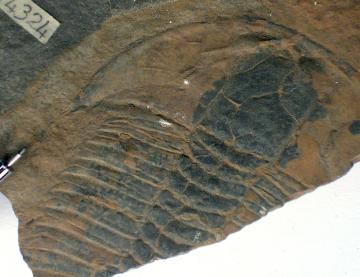 Trilobite: Elrathia (sp.) from the Burgess Shale. Photo by Steven Newton.
 This statement implies that the fact that we only find organisms that fit within our definitions of phyla is a circular reasoning problem. This misunderstands the fundamental tenet of common descent--that an animal has to evolve from something rather than spontaneously popping into existence.
According to Gould (1989), the fact that only 1 new phylum has originated since the Cambrian means that animal diversity has actually decreased since Cambrian times, since in early fauna such as the Burgess Shale all of today's major phyla exist plus many other phyla that are now extinct. There is considerable disagreement over Gould's argument.
One implication of this is that the majority of phyla came into being in a relatively short period of time, the ten million years between 535-525 Ma, followed by a dearth of new phyla. If a new body plan did not get in at the very beginning, at the "ground floor," then there would be little chance of its development at a later time.
Molecular phylogeny suggest a rather different story for the origin of the major phyla, in which:
1. echinoderms and chordates split ~ 670Ma (Ayala, 1998)
2. protosomes (arthopods, mollusks) and deuterostomes (chordates, echinoderms) split ~ 1.0-1.2 Ga (billion years ago) (Wray, 1996; Bromham, 1998)
A problem with these estimates, based primarily on protein-coding genes, is that rocks from the period of 1.2 Ga-0.67 Ga show little signs of active life at all. Bioturbation, the mixing of sediment layers by burrowing organisms, and trace fossils are not well expressed in the fossil record until early Cambrian times.