
Explore Evolution claims:
both Darwin's and Haeckel's comparisons left out the earliest stages of development.*
Whether this omission was intentional is a matter of some debate.
Explore Evolution, p. 68
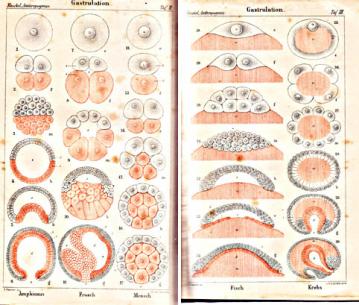 Eggs, cleavage stages, and gastrula stage embryos
 Vertebrate embryos (in the modern definition - after fertilization) have a number of stages such as the cleavage and gastrula stages which precede the embryos shown in Haeckel's diagram. 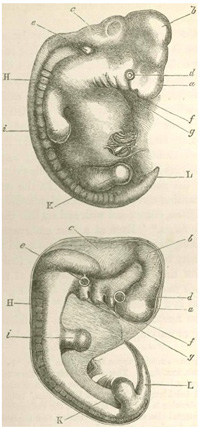 Darwin's Use of Embryonic Drawings Nick Matzke at Panda's Thumb has pointed out that comparisons of these earlier stage embryos are actually shown in Anthropogenie. Indeed, Anthropogenie has over 20 figures showing gastrula embryos from different groups. This does not reconcile with Explore Evolution's implication that Haeckel intended to deceive his readers.
Shown below are Plates 2 and 3 from Anthropogenie comparing eggs, cleavage stages, and gastrula stage embryos from different animals. As discussed earlier, Haeckel used von Baer's convention for embryo as the stage in which a body form is first apparent. Instead of describing these earliest stages of development as "embryos", Haeckel uses terms which include "keim" (meaning "germ"). For example, morula embryos are called "maulbeerkeim", and blastula embryos are referred as "blasenkeim".
In Descent of Man (1871), Darwin compared drawings of a human and dog embryo at the same stage (originally from Bischoff and from Ecker). However, nowhere does Darwin imply that this is the earliest stage of development. In fact, because dogs and humans are mammals and have very small eggs, their earliest stages of development are extremely similar. So it is absurd to suggest that Darwin purposefully left out the earliest embryonic stages of humans and dogs in order to mislead his readers.