
Explore Evolution mangles the tiny fraction of biogeography covered in this chapter. It is largely dedicated to an historical debate about whether early creationists disputed the fixity of species, a topic falling outside biogeography, and indeed the biology curriculum. The biological examples used are all instances of adaptive radiations on islands, an interesting topic, but not representative of the whole field.
Biogeography is an active field, exploring how geographic distribution of life is affected by history, climate, geology, and behavior. As predicted by evolution, the geographical arrangements of related species repeats in different groups. This comparison of multiple lineages shows how the shared history of an area produces similar patterns of common ancestry, and allows us to test hypotheses about evolution. The rapid ecological and morphological diversification of organisms on islands shows how quickly evolution can produce novelty. Explore Evolution ignores or dances around these points.
p. 75: "Gal pagos Islands, seen from Earth orbit"
Technically speaking, this image shows the Yucat n peninsula on Mexico's eastern shore. The Gal pagos are roughly 1500 miles south, in a different ocean.
p. 76: "Darwin was using [biogeography] to challenge the fixity of species."
Biogeography yields clear evidence for evolution not only of new species, but of new genera, families, etc., and examples of rapid evolution of morphological novelty. This is exactly opposite to the erroneous conclusion that Explore Evolution presents.
p. 76: "The evidence is just as consistent with the orchard picture as with the monophyletic view.
The same techniques that allow us to reconstruct evolutionary trees for a single lineage apply equally well to the entire tree of life. Biogeographic studies of a small family of insects may allow us to look deep into the evolutionary history of other branches of the tree of life. The consistency of these trees cannot be explained without reference to common descent. The creationist "orchard" is scientifically vacuous.
p. 78: "a mechanism that can transform one type of animal into a fundamentally different type of animal.
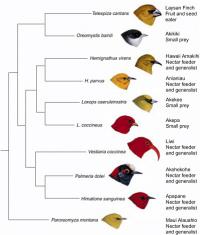 Hawaiian Honeycreepers: These very different species descended from a single ancestor in the last ten million years. Steve Olson (2004) Evolution in Hawaii. The National Academies Press:Washington, D.C.
 The adaptive radiations of honeycreepers in Hawaii (and many other groups) represent a range of variation that meets any fair definition of "fundamentally different." Explore Evolution never defines this term, and its use in a definition of "macroevolution" is scientifically inaccurate.
p. 78: "Marsupials are not restricted to Australia and South America the opossum live[s] in the northern hemisphere the oldest marsupial fossil [was found in] China."
The best evidence is that marsupials originated in Asia, migrated across a land bridge to the Americas, and across Antarctica to Australia. The Asian and North American marsupials went extinct, while the Australian and South American populations speciated and radiated in behavior, ecology and morphology. Extinction, migration and diversification are important parts of biogeography and evolution, and Explore Evolution does students a disservice by ignoring or misrepresenting these processes. The total omission of plate tectonics from this discussion is inexcusable.
p. 79: "Scientists disagree about how to interpret the evidence we have examined."
Scientific inquiry takes disagreement as a basis for new research, not as a chance to declare that "there may not be much further debate" and "the issue is likely to remain exactly where it is." This is not inquiry; it is surrender. It not only misleads students about the actual state of scientific knowledge, it misinforms them about the way science works.
Major Flaws:
Fixity of species and common descent: Biogeography allows powerful tests of particular hypotheses about evolutionary histories. Explore Evolution wrongly claims that biogeography is only relevant to tests of species fixity, but offers no testable claims to justify arguing that the biogeographic evidence is equally consistent with common ancestry or with creationist orchards.
Evolution on Islands: Studying island biogeography is important, but biogeography encompasses much more than Explore Evolution offers readers. What the book covers omits crucial information about the motion of the continents over time, falsely claims that island biogepgraphy does not show novel features evolving on islands, and introduces confusing and erroneous information about the few examples examined in detail.